

What Is Lesbian Visibility Week?
A little history lesson

This is the Sunday Edition of Paging Dr. Lesbian, an AI-free, self-funded, queer media project. If you’d like to support my work as a full-time journalist in an increasingly unstable industry, please consider upgrading your subscription. It will get you weekly news updates, a monthly playlist, and a free sticker.
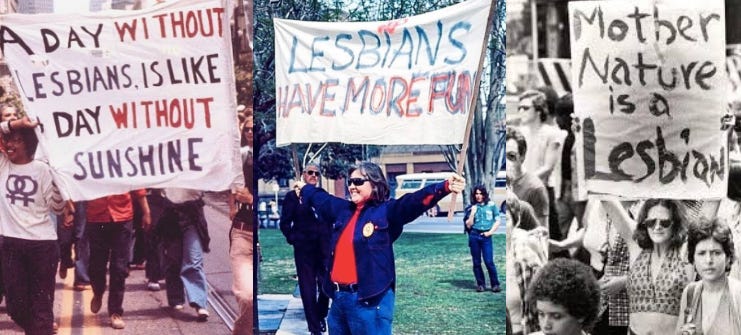
Open the window and stick your head out — can you hear that? It’s the sound of a million lesbians screaming into the void. Today marks the final day of Lesbian Visibility Week, a time when lesbians celebrate themselves, each other, and raise awareness of issues facing the community. You may have seen folks posting about it online, but do you know anything about its history?
As far as we can tell, the first Lesbian Visibility Week in the United States took place in West Hollywood in 1990. Co-founded by the West Hollywood Lesbian Visibility Committee and the Los Angeles Gay and Lesbian Center, the week was “a combination of cultural programming, workshops addressing current and impending needs, awards ceremonies, and social events.” Lesbian Visibility Week continued to be celebrated in Southern California for several years, but it didn’t gain national traction until the 2000s. (New Zealand and Canada supposedly held Lesbian Visibility Weeks as early as the 1980s.)
In 2008, activist Amy Ellis is said to have started the annual observation of Lesbian Visibility Day on April 26, though we have little evidence from this period. In its modern iteration, Lesbian Visibility Week was founded by Linda Riley, publisher of the UK’s DIVA magazine, in 2020. Riley came to the conclusion that lesbians needed more than a single day to celebrate and be visible. She was also concerned about the negative connotations surrounding the term ‘lesbian’ and assumptions about inclusivity. Speaking with The Advocate in 2022, Riley explained,
“I had noticed that more and more, the L in LGBTQ+ was becoming particularly marginalized. I am a proud cis lesbian and a proud trans ally. But many in the LGBTQ+ community were beginning to equate cis lesbians with transphobes, which is fundamentally untrue. I wanted to help create a narrative that shows once and for all that the vast majority of cis lesbians are inclusive. We are intersectional. We want to remove any negative connotations associated with that word. So this is why during Lesbian Visibility Week we celebrate and center all lesbians, both cis and trans, while also showing solidarity with all LGBTQ+ women and nonbinary people.”
In North America, Lesbian Visibility Week is sponsored by organizations like the Curve Foundation, an offshoot of Curve Magazine, as well as GLAAD. The theme for 2026 is Health and Wellbeing. “Our aims remain clear: to build public understanding of LGBTQIA+ women and non-binary people’s lives, to increase lesbian visibility and to create a legacy that benefits our community everywhere,” read the official Lesbian Visibility Week website.
Lesbian Visibility is celebrated in a myriad of ways. Curve Magazine publishes the Curve Power List, which honors influential lesbians in fields like STEM, entertainment, activism, and sports. In 2023, Lesbian Visibility Week made it to the White House, as The L Word stars Leisha Hailey, Jennifer Beals, Katherine Moennig, along with L Word creator Ilene Chaiken, joined press secretary Karine Jean-Pierre for a special press briefing. Unsurprisingly, the White House has not acknowledged Lesbian Visibility Week this year.
Though you may be primarily aware of it via online posts, Lesbian Visibility Week sponsors virtual and in-person events across North America and the UK. Events include a Queer Women in Sports Day, a lesbian speaker series, flag-raising ceremonies, an Earth Day Salt Marsh walk in Provincetown, a queer women’s history walk in the Castro district, a sound bath in Lily Dale, NY, a lesbian arm wrestling competition in Portland, OR, and The Great Lesbian Pie Eating Contest in Winnipeg.
Of course, most lesbians celebrate Lesbian Visibility Week by posting about it on the internet. On X, one user uploaded an iconic clip from The L Word depicting Jenny and Alice’s argument about artistic license and Monet, among other things. “lets celebrate amazing lesbian writing on our visibility week,” they wrote. A number of folks took the opportunity to post photos of themselves and/or their girlfriends/spouses. Others bemoaned the tragedy of celebrating Lesbian Visibility Week without a girlfriend. MUNA’s Katie Gavin celebrated lesbian visibility by posting nudes on main. On Bluesky, many users posted NSFW artwork or furry-related content to promote visibility.
Considering the centrality of fandom on social media platforms like X, it’s not surprising that many users celebrated Lesbian Visibility Week by shouting out their favorite fictional characters or couples. “Happy lesbian visibility week to them” or “happy lesbian visibility week to her” were common refrains as fans posted their favorite lesbian or lesbian-coded media. Posts included characters from Pluribus, 9-1-1, Adventuretime, Arcane, Agatha All Along, The Pitt, and House of the Dragon, to name only a few. Others interpreted lesbian visibility differently, such as the fan who posted a series of photos of Taylor Swift wearing the colors of the lesbian flag or the fan who posted a photo of someone holding up a “Lesbians for Louis” flag in front of former One Direction member Louis Tomlinson.
On Threads, a debate erupted about language. Some users posted lists of books to read for Lesbian Visibility Week, and others noted that some of these books — included under the broad umbrella of “sapphic book recs” — didn’t feature any lesbian main characters. Several users got annoyed about the concept of “sapphic book recommendations” during Lesbian Visibility Week because of how it contributed to lesbian erasure, while others took umbrage with lesbians not wanting to be called sapphic, claiming they were being exclusionary.
Clearly, queer language remains a hotly contested subject online, though one wonders if such debates would ever occur IRL, such as at a lesbian pie-eating contest, for example. Ironically, both the meaning and the origins of Lesbian Visibility Week lack visibility, though this isn’t surprising considering the myopic, often ahistorical nature of the internet. Being a lesbian means different things to different people, and visibility is a slippery subject. Watching gay movies or going on gay walks means being visible to some, while others stare longingly at their phones. It’s all equally lesbian.
How did you celebrate Lesbian Visibility Week? If you could plan any event for Lesbian Visibility Week, what would it be? Let me know in the comments.
lesbian breakup of the century

an earth-shattering lesbian breakup. gay witches and gay stoners. plus, this month's playlist.
I celebrated by watching Ghost with my long-distance lesbian girlfriend 💗
Cheers to lesbian visibility week! I publish ed my first lesbian romance book 📚 Woo hoo! I am grateful to be able to live out loud and proud! I am working to create a world where everyone can feel safe and free to be who they are and love who they love! Great article! 📝