

Brydie O’Connor On Her New Documentary 'Barbara Forever'
An evocative look at one of our most important lesbian filmmakers

This is the Sunday Edition of Paging Dr. Lesbian, an AI-free, self-funded, queer media project. If you’d like to support my work as a full-time journalist in an unstable industry, please consider upgrading your subscription. It will get you weekly news updates, a monthly playlist, and a free sticker. A reminder that you can now get the newest issue of Autostraddle’s print magazine, which I’m featured in!
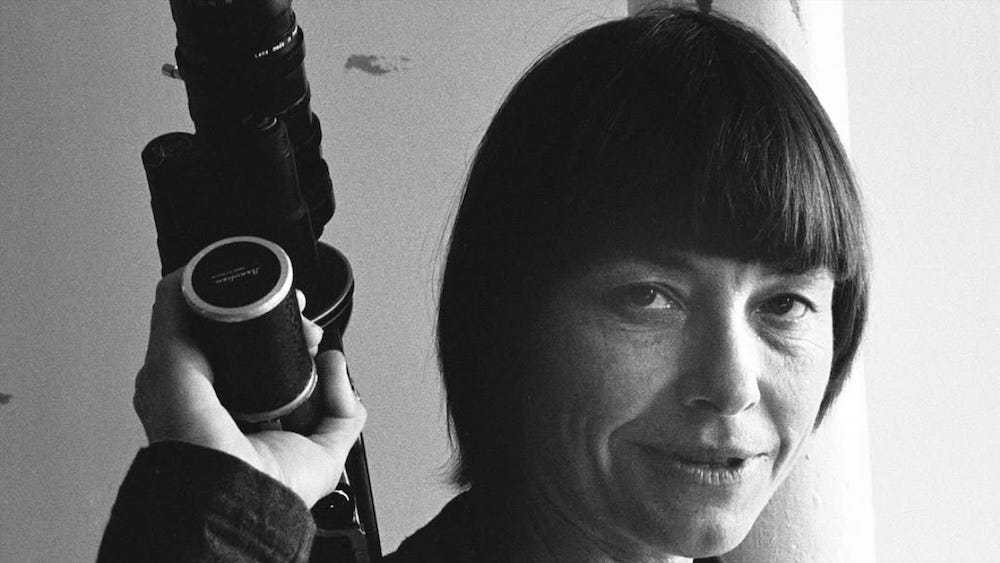
If you’re not familiar with the work of Barbara Hammer, now is the time to get acquainted. The pioneering lesbian filmmaker made more than 80 short and feature-length films in her lifetime (she died in 2019), all of which focused on lesbian life in some way. Her films often featured nudity and eroticism because, as she notes in the film, “Touching another woman changed my life. It had to be shown.”
Barbara Forever, directed by filmmaker and archivist Brydie O’Connor, takes an immerseive, expansive approach to Barbara’s work and life, letting the filmmaker tell her story in her own words. As Barbara professes in the documentary, “I want to exist forever,” and this project works to cement her legacy and expose her work to a broader audience. I spoke to filmmaker Brydie O’Connor about making the film — we talked about style, structure, the work of an archivist, and why she wants people to see the film. You can check out our conversation below.
Barbara Forever will premerie in theaters next month. In opens in NYC on 9/4 at the Film Forum, in LA on 9/11 at Laemmle Royal, and in San Frasisco on 9/18 at The Roxie. For my folks in Seattle, it will screen at Northweset Film Forum starting 9/16. Following this limited release, it will expand to theaters nationwide via Strand Releasing. You can find info about screenings and by tickets at barbaraforeverfilm.com.
How did you come to direct this film? What drew you to the subject matter?
I’ve been in the Hammer world for nearly ten years now, and I originally gravitated toward Barbara Hammer and her work when I was in college trying to find lesbian films that were actually made by lesbians. I wrote my thesis on Barbara’s early filmography, particularly her films from the 1970s, and had to reach out to her directly to buy her DVDs. This is how Barbara and I originally connected.
I was very inspired not only by Barbara’s films, but by the way she approached making them. She was incredibly prolific, ultimately making more than 85 films. She initially started making films from an impulse to create images that reflected her perspective as a lesbian and a woman, and that could convey both physical and emotional feeling. I was moved by Barbara’s impulse to take creative risks, to start making films in her late 20s, and to learn and express herself through the process of making.
This approach resulted in these incredibly specific depictions of lesbian bodies, desire, and community, but it also opened up a pathway for me personally. Encountering Barbara’s work genuinely made me feel like I could try making art of my own. I owe that to her, and I’m so grateful that her work became such a touchstone for me in imagining how to be a lesbian artist in the world.
There’s a quote from Barbara in the film where she says, “a lesbian film is not going to follow a traditional story.” Was this something you were thinking about while making the documentary? Did you find yourself imitating Barbara’s style as a filmmaker?
From the beginning, I knew I didn’t want to make a traditional cradle-to-grave biography about Barbara Hammer, and wanted the form to reflect her expansive, experimental life. We talked a lot in the edit about approaching the structure through a “queered chronology,” allowing time to move fluidly through the past, present, and future. In this way, the contemporary scenes not only show how Barbara’s legacy continues to unfold in the present, but allow us to experience the future she envisioned for her work and impact. Living in the future Barbara had a hand in creating makes her feel particularly present, and active, in the film.
Rather than simply imitating Barbara’s filmmaking style, this approach was rooted more in making a documentary about Barbara Hammer that is inherently queer in both its content and its form. And “queer” here also means allowing ourselves to work outside the constraints of what is traditionally expected, and to question conventions. I felt that the best way to honor Barbara’s ethos was not to imitate her work, but to harness the same creative permission she gave herself and use it to make something new.
In her book, Barbara discusses how she wants to be remembered, and it’s clear legacy was something she thought about a lot. How much of the film is an effort to preserve Barbara’s legacy in a way she would have wanted, and how much of it concerns your own relationship with Barbara’s work?
I think those two things are really intertwined for me. Barbara was incredibly intentional about her legacy, but she also didn’t think of an archive as something static. She wanted her films to continue to be watched, engaged with, questioned, and recontextualized after her death. I was really excited by the idea of Barbara continuing to have a hand in her own legacy, which is one reason it felt so important that she narrate the film herself.
At the same time, this is inevitably my relationship to Barbara and her work. I’ve spent almost ten years with her films now, and my understanding of them has changed as I’ve changed. When I first encountered Barbara, I was especially drawn to the exuberance and immediacy of her early work – this young lesbian turning the camera on her life and insisting that her perspective mattered. Over time, I became increasingly interested in how her relationship to her own body changes across her filmography, from documenting sex and desire to documenting aging, illness, and dying.
I think of the film less as an attempt to encapsulate Barbara’s legacy than as an effort to keep it moving. Barbara was constantly evolving, and she wanted her work to continue evolving beyond her lifetime. I see the film as part of that living archive.
Much of your work is archival in nature, and you’ve worked as an archival producer on films like We Are Pat, which I wrote about recently. What draws you to archival work, and why are you interested in highlighting queer archives in particular?
I really love archival work. With a background in archival producing, I’ve come to understand that the job isn’t simply to find material that illustrates the ideas being discussed. I’ve found I’m much more interested in how archival material can actually drive a story and stand on its own as a cinematic language. Something I pay attention to is specificity and letting material speak for itself.
I’m particularly drawn to personal and queer archives because so much of queer history has been preserved outside of traditional institutions, and oftentimes exists in things people saved without necessarily considering that they were contributing to a historical record. I connect with Barbara so closely over her belief that documenting and preserving her everyday life could become an alternative method of history-making, and that these fragments would ultimately expand the collective cultural memory of lesbian lives.
Barbara has a massive archive of films and other artistic materials. What was the experience like of going through her archive, and how did you decide what to include in your film?
Barbara’s archive is definitely massive, and we knew very early on that the film couldn’t – and shouldn’t – try to be comprehensive in a traditional biographical sense. The guiding question that I continued to return to was: why did Barbara so constantly turn the camera on herself in this really intimate way?
That question really became the organizing principle for the film and helped us distill and prioritize material within a huge, sprawling collection of incredible material. Ultimately, we included the material that best represented Barbara’s impulse to document her own body across a lifetime, creating a record of a lesbian life from birth to death, entirely on her own terms.
Why do you want people to see Barbara Forever?
On a practical level, I want people to see Barbara Forever and then go seek out Barbara Hammer’s films. Barbara is still under-recognized within the broader history of cinema, and I’m especially excited by the possibility that this film can introduce her to younger queer audiences who might be encountering her for the first time.
Barbara Hammer steadfastly believed that her perspective mattered, and she gave herself permission to make the work she wanted to make – to evolve, to experiment, to desire, to fail, and to keep going. I hope people leave the film asking themselves how they might integrate some of Barbara’s way of being into their own lives, and how that sense of possibility might shape the futures they imagine.
