

10 Books to Read This Summer
Touch grass! Read a book! Do both at the same time!

This is the Sunday Edition of Paging Dr. Lesbian, an AI-free, self-funded, queer media project. If you’d like to support my work as a full-time journalist in an unstable industry, please consider upgrading your subscription. It will get you weekly news updates, a monthly playlist, and a free sticker.
Exciting news — I wrote a piece for Autostraddle’s print magazine about gay kickball leagues! You can get a copy of the magazine here.
Reading is one of the best things you can do for your brain, I think. It’s a good way to forget about your worries, get smarter, expand your imagination, and strengthen your empathy for others. If you find the right book, it should also be a lot of fun. I’m always on the hunt for my next favorite book, and to that end, I’ve compiled a list of books that I’ve read recently and loved, and that I think you should read, too.
These are not summer reads insofar as they’re all light and breezy — it literally just happens to be summer. There’s a bit of horror in here, some love stories, and some great literary fiction. I hope you’re able to find something you love on this list! Let me know if you’ve already read any of these in the comments below.
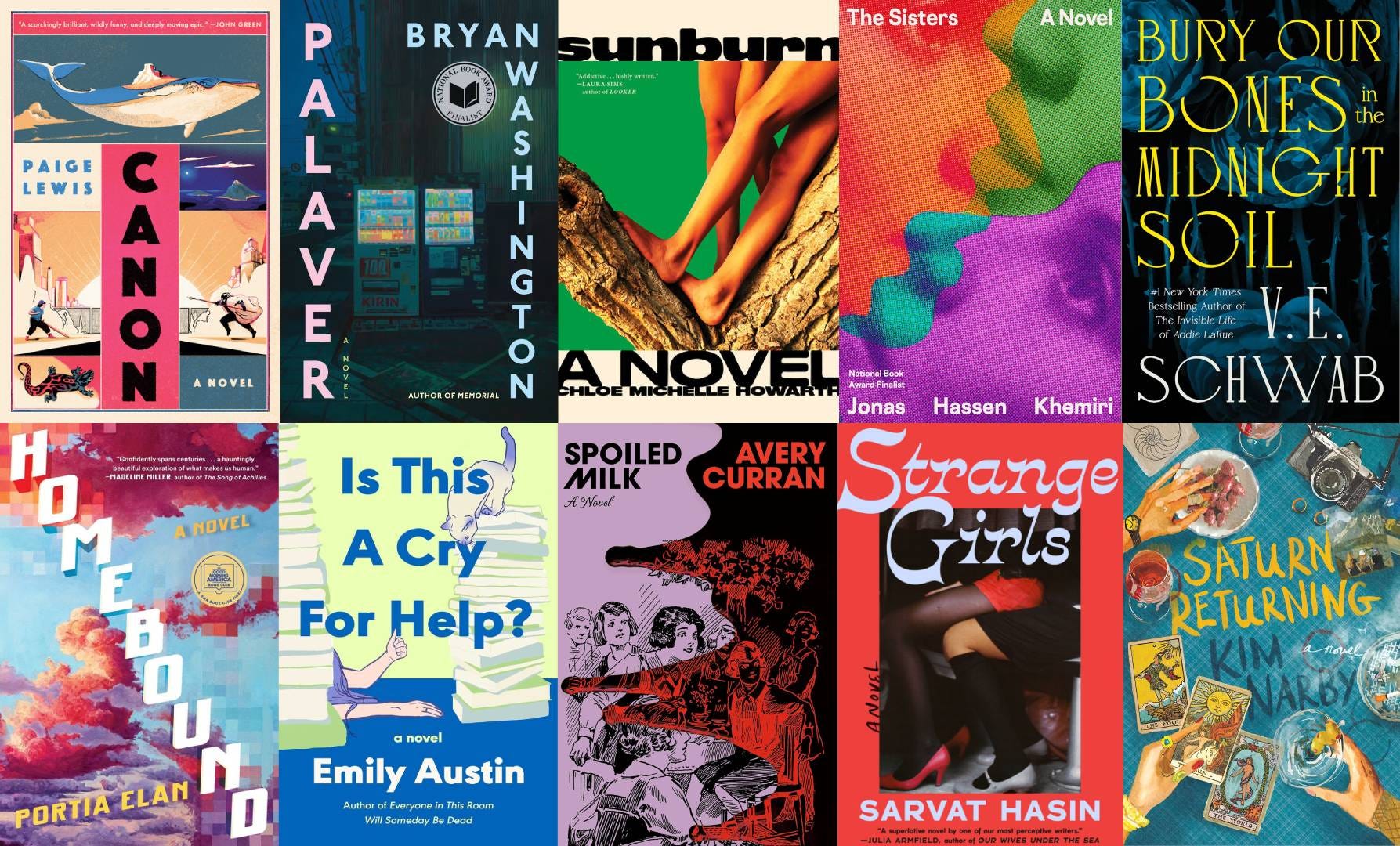
Canon by Paige Lewis
Paige Lewis’ Canon is sort of like The Odyssey and The Bible if they were written by a Gender Studies major, and I mean that as a compliment. The book follows Yara, a non-binary artist with OCD. They are chosen by God (yes, God) to be the hero who slays Dominic, the leader of the Bad Guys. They embark on a journey complete with a series of missions that test their mettle as a hero. Elsewhere, the prophet Adrena is disappointed that God has stopped speaking to her, and tries to convince Harpo, the leader of the Good Guys, that she has a plan ordained by God.
Canon is filled to the brim with references — to Homer, The Bible, pop culture — and wit on every page. It features a talking whale, who is probably the best character in the book, and a God who is something of a pompous asshole. It won’t work for everyone, but I found it wonderfully cheeky and a delight to read.
Is it gay? Yes, the two main characters are both queer.
The Sisters by Jonas Hassen Khemiri
The Sisters is a 600-page novel that you won’t want to put down. It follows the Mikkola sisters: Ina, Evelyn, and Anastasia. They were raised by their mother, an erratic Tunisian carpet seller, after their Swedish father left them. Ina, the eldest, is organized and no-nonsense, while middle child Evelyn is a charming people-person. The youngest daughter, Anastasia, is spontaneous and moody. The story of their lives is told by Jonas, raised by a Swedish mother and a Tunisian father, who knew the sisters briefly as children.
We follow the Mikkola sisters as they grow into young women, finding love and careers, while Jonas embarks on a parallel path of his own. Their journeys take them to Stockholm, and later to New York City, where Evelyn and Jonas confront a curse put on the Mikkola family. A decades-spanning novel filled with personality and bold characters, The Sisters ponders fascinating questions about the nature of storytelling and who has the right to tell someone’s story. The structure is equally captivating, as it moves slowly, and then more quickly, and then all at once, until these lives have been lived to their fullest.
Is it gay? Yes, a bit, as one of the sisters is queer.
Bury Our Bones in the Midnight Soil by V.E. Schwab
A hot queer book from last year, V.E. Schwab’s Bury Our Bones in the Midnight Soil looks at the myth of the vampire from a very lesbionic perspective. We follow three different women, whose lives (and deaths, as it were) began centuries apart. In the 1500s, María, a young, wild girl, grows up in Spain and chooses immortality over being an obedient wife. In the 1880s, a Brit named Charlotte is sent to London to make her debut as an eligible young woman, only to be swept off her feet by someone quite different than she imagined. And in 2019, Alice, a Scottish student who fled to Boston for college, has her life flipped upside down after a night with a mysterious stranger.
I’ve always loved vampire lore, and Schwab’s offers a fresh take on the many myths of the undead. She homes in on the concept of hunger, making a connection between queerness and hunger that spans centuries. Insatiable hunger is often linked to monstrosity, and the book looks at deviance from a distinctly queer perspective. It’s a great entry in the lesbian vampire canon (Schwab also wrote the short story First Kill is based on).
Is it gay? Yes, very much so.
Homebound by Portia Elan
One of only three five-star books I’ve read this year (according to my Storygraph account), Homebound was an immediate favorite for me. The centuries-spanning work follows several people across time and space with a profound connection to each other, in a way that reminded me of another favorite of mine, Cloud Cuckoo Land. (I recommended this book in a previous list.)
In 1983 Cincinnati, 19-year-old Becks grieves the loss of her uncle, the only person who ever truly understood her. In her grief, she sets about completing the text-based video game he started, about an astronaut lost in space. In 2078, Dr. Tamar Portman creates sentient robots called Ayes, meant to heal and repair an ailing planet. In 2586, Yesiko traverses the world, now mostly underwater, in a salvage ship called Babylon, trying to keep her only crewmate, Root, alive. Tying them all together is a robot who’s beginning to forget all the memories it was built to carry, but may hold the key to human nature.
Author Portia Elan weaves these stories together beautifully, imbuing each with hope despite the often desperate circumstances these characters face. If you’re interested in a robot making you cry, check this book out.
Is it gay? Yes, at least one of the characters is queer.
Is This a Cry for Help? by Emily Austin
Emily Austin brings her distinctive voice to Is This a Cry for Help?, which follows a woman experiencing a mental breakdown. Darcy is a lesbian librarian living her best life with her doting wife, Joy, in a beautiful old house by the lake. Darcy’s sense of peace is fractured when she finds out that her ex-boyfriend of many years, Ben, has died. Ben’s death sends Darcy into a whirlwind of guilt and shame, and she winds up on medical leave from the library.
The novel follows Darcy as she works to get her sanity back, diving head-first into library politics and, somewhat begrudgingly, therapy. Her job becomes more complicated when a right-wing group begins protesting what they see as controversial content offered at the library, putting Darcy on the front lines of a culture war. Like Austin’s other books, Is This a Cry for Help? features an offbeat protagonist with a unique POV and a captivating inner world.
Is it gay? Yep, very gay.
Spoiled Milk by Avery Curran
Avery Curran’s Spoiled Milk takes place at a boarding school in 1928. During Emily’s final year at Briarley School for Girls, tragedy strikes. Violet, the most popular girl in school and Emily’s best friend, tragically dies on her eighteenth birthday. Emily suspects the French schoolmistress was involved, as she and Violet had a suspiciously intimate relationship. As Emily sets about to solve the mystery of Violet’s murder, she teams up with Evelyn, her nemesis and another one of Violet’s adoring fans.
It only gets stranger from there. Bizarre, ominous things keep happening at Briarley, including a rotting food supply and more dead girls. Emily and her classmates turn to spiritualism for answers, holding seances to talk to their dearly departed Violet, but this only leads to more bad omens. Spoiled Milk recalls the queer boarding school narrative of Mädchen in Uniform mixed with supernatural horror. Curran’s gothic novel features haunting meditations on queer desire, repression, and coming-of-age in a wonderfully spooky setting.
Is it gay? Yep, very much so.
Strange Girls by Sarvat Hasin
Strange Girls is one of the best books I’ve ever read about an intimate, complex friendship between two women. The friends in question are Ava and Aliya, who met in college and forged an intense connection. They bonded over their love of writing, sharing stories and creating an insular world of their own making. When the real world catches up to them, their bond is threatened by differing priorities and family obligations. Aliya wants to live up to the expectations of her Pakistani family, while Ava is desperate to be free of her erratic mother.
A decade later, Ava and Aliya reunite for a friend’s wedding after a protracted period of silence. Can they repair their friendship after so many years apart? Will they be able to reckon with the nature of their relationship? Tensions rise when Ava discovers Aliya has written a book (something Ava has always dreamed of doing but never had time for), the contents of which threaten to tear them apart. I loved Strange Girls, and Sarvat Hasin does a masterful job exploring the nuances of Ava and Aliya’s friendship and the small moments that can make or break a relationship.
Is it gay? Yes, in a multitude of ways.
Saturn Returning by Kim Narby
Kim Narby’s Saturn Returning is a tangled tale of three friends with an inextricable connection. Jordan arrives as a freshman at McCallen College and meets Trace, a confident lesbian and a sophomore RA. They become quick friends, and their meeting feels like fate. Shortly thereafter, Jordan and Trace meet Sylvia, a charming, mysterious transfer student. Jordan and Sylvia become friends while working at a diner together, and Trace becomes enamored with Sylvia. The two begin a relationship, for which Jordan often acts as the mediator.
Ten years later, Jordan is working as a photographer in New York, while Trace and Sylvia are living together in Seattle, newly engaged. The three friends have gone through many ups and downs over the years, but a shocking revelation threatens to tear them apart for good. The characters in Saturn Returning are all carefully drawn, and they feel like real people with a past, present, and future. The relationship between these three women is wonderfully complex and fascinating, and Kim Narby captures so much nuance by showing us all of their perspectives.
Is it gay? Yep, super gay.
